
In a dramatic turn of events, the European Union and the United States have reached a preliminary tariff agreement after months of tense negotiations and threats of an escalating trade war. This blog unpacks the negotiation timeline, key deal terms, internal EU reactions, and the broader geopolitical implications of this landmark agreement.
1. Initial Deadlock and American Ultimatum
The conflict began with a clear warning from the US: if no deal was reached by August 1st, the US would impose a 30% tariff on EU goods. The EU attempted to reach a resolution during talks on July 15, 2025, but negotiations broke down. The US accused the EU of taking advantage of the transatlantic trade relationship and demanded a correction. The EU countered, saying that 30% was excessive and they could only accept a 10% rate.
Following the failure, the US reaffirmed its threat to impose the full 30% tariff. In response, the EU prepared a €720.1 billion countermeasure package, targeting US aviation and automotive exports, steel and chemical imports, and potentially restricting access to its digital and financial markets.
2. Von der Leyen Steps In: A Tentative Framework
To break the impasse, European Commission President Ursula von der Leyen spoke directly with Donald Trump on July 25 and met him in person on July 27 in Scotland. After months of uncertainty, a framework was finally agreed upon:
- The US will impose a 15% tariff on approximately 70% of EU exports, including cars, semiconductors, and pharmaceuticals.
- Steel and aluminium tariffs will remain at 50%.
- In return, the EU will not impose retaliatory tariffs, aiming for parity in response.
- The EU agreed to ease sanitary restrictions on US pork and dairy products and remove some non-tariff barriers on US agricultural imports.
- The EU will purchase $750 billion worth of US energy and invest $600 billion into the US, including arms purchases.
- Trump demanded that all EU commitments be fulfilled by 2028.
3. Who Will Pay the Tariffs? Trump’s Strategy
According to US media, the new 15% tariff will be absorbed by the EU, not passed on to American importers. Trump has pressured the EU to lower the price of their exports, thereby maintaining volumes while erasing the trade surplus.
Von der Leyen called the deal “a good agreement” during a press conference, admitting that while 15% is hard to accept, “this is the best outcome we could get.”
4. Diverse Reactions Across EU Member States
🇩🇪 Germany

Mixed feelings. Pleased that a trade war was averted—crucial for Germany’s export-driven economy—but disappointed that the 15% tariff remains high.
🇫🇷 France
Unhappy across the political spectrum. The Prime Minister called it “France’s darkest day”. Businessman Arnaud Bertrand likened it to “colonial-era unequal treaties”. President Macron urged the EU to take a tougher stance against the US.
🇳🇱 Netherlands
The Dutch government, facing a trade deficit with the US, argued the deal was unfair and called for further negotiations.
🇵🇹 Portugal
As the US is Portugal’s fourth-largest trading partner, it fears economic harm and seeks exemptions from the tariffs.
🇮🇹 Italy
Foreign Minister estimated a €1.4 to €15 billion annual loss due to the tariffs. However, Italy appears willing to accept the deal to avoid a 30% tariff risk.
🧠 Psychological Pressure
The EU had previously criticised the UK for accepting a 10% US tariff as “humiliating,” yet now accepts a 15% rate itself, creating internal legitimacy challenges.
5. The UK’s “Brexit Dividend” Moment
The UK media reacted with glee. Former PM Johnson’s advisor, Dominic Cummings, claimed Brexit had saved Britain from a “disastrous deal.” Even anti-Brexit Prime Minister Keir Starmer coined the term “Brexit dividend,” arguing that being outside EU trade structures gave the UK greater freedom. Britain, for example, only faces a 10% tariff from the US.
6. Why the EU Caved In
- Avoiding a full-scale trade war: With the August 1st deadline looming, the EU feared painful retaliation. Trump had threatened further escalation if the EU responded harshly.
- Military and geopolitical concerns: There were fears Trump might pull the US out of NATO or invite Russia into the G7.
- Strategic trade-offs: The deal offers zero tariffs on strategic goods such as aircraft, semiconductors, and key raw materials.
- Big-picture ideology: The EU compromised to avoid mutual destruction and geopolitical fragmentation that could benefit rising economies like India.
7. Legal Uncertainty and Trump’s Reputation
Trump’s credibility remains low. The agreement is just a framework, lacking legal binding power. It still needs approval from all EU member states and the European Parliament.
Confusion remains even on key points. For example, Trump says pharmaceuticals aren’t covered, while Von der Leyen claims they are, capped at 15%.
8. Trump’s Delay Tactic and “Limited-Time Offer”
Trump delayed implementation of the 15% tariff from August 1st to August 7th, giving the EU extra negotiation time.
He also offered a “limited-time exemption”—goods shipped before August 7 and arriving before October 5 would be exempt from the new tariff, pressuring the EU to sign quickly.
9. EU’s Ongoing Negotiation Goals
The EU has several focus points:
- 15% tariff: The EU is reluctantly prepared to accept it.
- Steel industry: Wants a quota-based exemption, with the 50% tariff only applying beyond set limits.
- Digital and agriculture barriers: Will ease sanitary certifications, but will not relinquish regulatory sovereignty completely.
- Pharmaceuticals: Especially vital for Ireland, the EU demands a 15% cap. There’s concern about fairness with Northern Ireland (UK) paying only 10%.
- Energy & Investment: These large commitments depend heavily on private sector execution and are unlikely to meet full targets. The underlying goal is to de-Russify Europe and deepen reliance on US energy.
The EU also seeks quotas for alcohol and agricultural goods.
10. Conclusion: Strategic Loss for the EU?
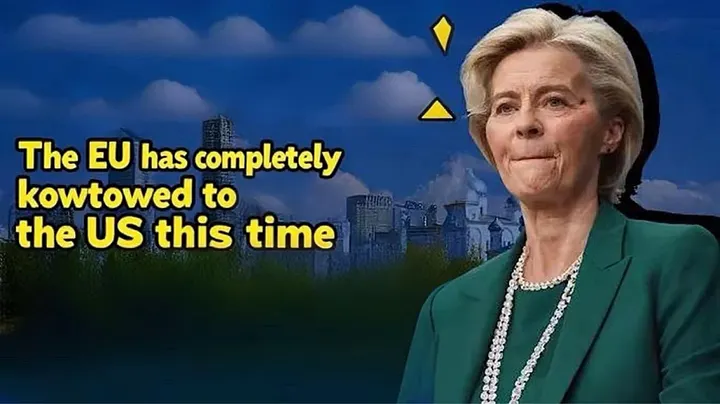
The video’s conclusion was blunt: “The EU kneeled pretty hard.” Even if the US accepts all EU proposals, the larger loser appears to be Europe.
In the short term, the deal prevents a damaging trade war. In the long term, however, the EU’s perceived weakness may reduce its leverage in future negotiations and diminish its status as the world’s third power in global geopolitics.
The deal is not yet signed. Some countries—especially France—might resist. As it stands, “everything is still possible”.
Stay tuned for updates. Whether the EU will cave or fight back—remains to be seen.